
Scrapping your car in Manchester takes less than an hour of your own time, even though the full legal process runs for about two weeks in the background. Our scrap car collection in Manchester service works simply: you get an instant quote, book a free collection, hand over your keys on the day, and receive payment directly to your bank account, often the same day. Below is the complete process, step by step, including the parts most guides skip: the paperwork you need to sort before the driver arrives, the exact fines you’re risking if you skip a step, and what to do if something unusual applies to your situation.
If you want to skip straight to a price, you can get an instant scrap car quote here with no obligation.
What You Need Before You Start
Before booking, gather the following:
- Your V5C logbook if you have it, you will sign and post Section 9 to DVLA after collection
- A form of ID (driving licence or passport)
- Your bank details for payment
- All keys to the vehicle, including spare keys
If you have lost your logbook, that is not a problem. You can scrap a car without a V5C in Manchester, Authorised Treatment Facilities (ATFs) can accept vehicles without logbooks provided you can prove ownership through a V62 form or original purchase receipt. If you would rather sort a replacement logbook first, our guide on getting a replacement V5C from DVLA covers the online, phone, and postal routes and how long each one takes.
If your car is wearing a private or cherished number plate, deal with this before anything else. Once your vehicle is scrapped, the registration cannot be recovered under any circumstances, and this cannot be sorted retrospectively after collection. Our full guide on how to keep your number plate before scrapping your car walks through the DVLA retention process and how long it takes, plan for this before you book a collection date, not alongside it.
Step 1: Get Your Scrap Car Quote
Call us or fill in the online form with your registration number and postcode. We calculate your price based on:
- The current scrap metal price per tonne (this changes week to week with the global steel and non-ferrous metal markets)
- The vehicle’s kerb weight
- Whether it is a runner or non-runner
- Your location within Greater Manchester
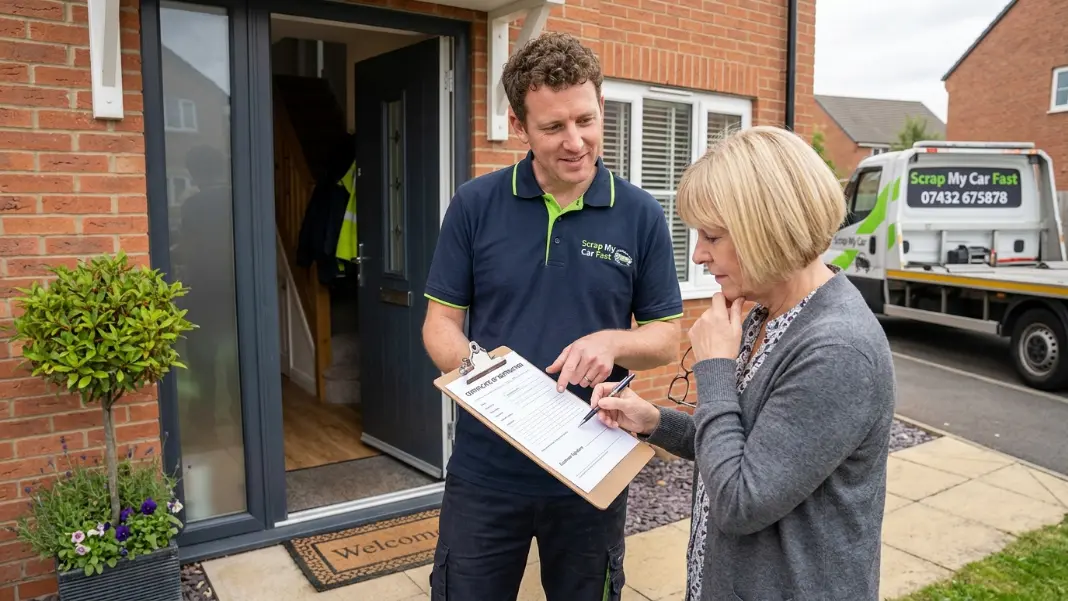
For a typical family hatchback in the M or SK postcode areas, scrap car prices in Manchester currently range from £80 to £350 depending on weight and condition. Heavier vehicles like MPVs, SUVs, and vans tend to fetch more, since scrap value is driven primarily by how much recoverable steel and metal is physically in the vehicle. We do not change the price on collection day, the quote you receive is what you get paid, regardless of how the market moves between quote and collection.
Step 2: Book Your Collection
Once you accept the quote, we book your collection. We’re based in Salford and cover all of Greater Manchester from there: Manchester, Salford, Stockport, Bolton, Rochdale, Oldham, Bury, Wigan, Tameside, and Trafford. Most collections in M, BL, and OL postcodes can be done same-day or next morning.
You do not need to drive the car anywhere, and in some cases you legally cannot. If your car is untaxed, uninsured, or without a valid MOT, it is not legal to drive on public roads, even for a short trip to a scrapyard, so it needs to be collected or transported rather than driven there yourself. This is exactly what our collection service exists for. Our driver comes to your address, whether that is a residential street, a shared car park, or a private driveway. If the car is not accessible by a standard truck, let us know when booking and we will bring the right equipment.
Step 3: Prepare Your Car
No deep clean needed. You do need to:
- Remove all personal belongings including the boot, glove box, door pockets, and under the seats
- Remove any aftermarket parts you want to keep (dashcam, sat nav, private number plate)
- Confirm your private registration plate has already been through DVLA retention if you’re keeping it, this needs to be done before the driver arrives, not on the day
- Make sure the car is accessible on the day
If the car does not start, that is fine. We collect non-runners across Greater Manchester using a flatbed truck at no extra charge. Leave it as it sits.
Step 4: Collection Day
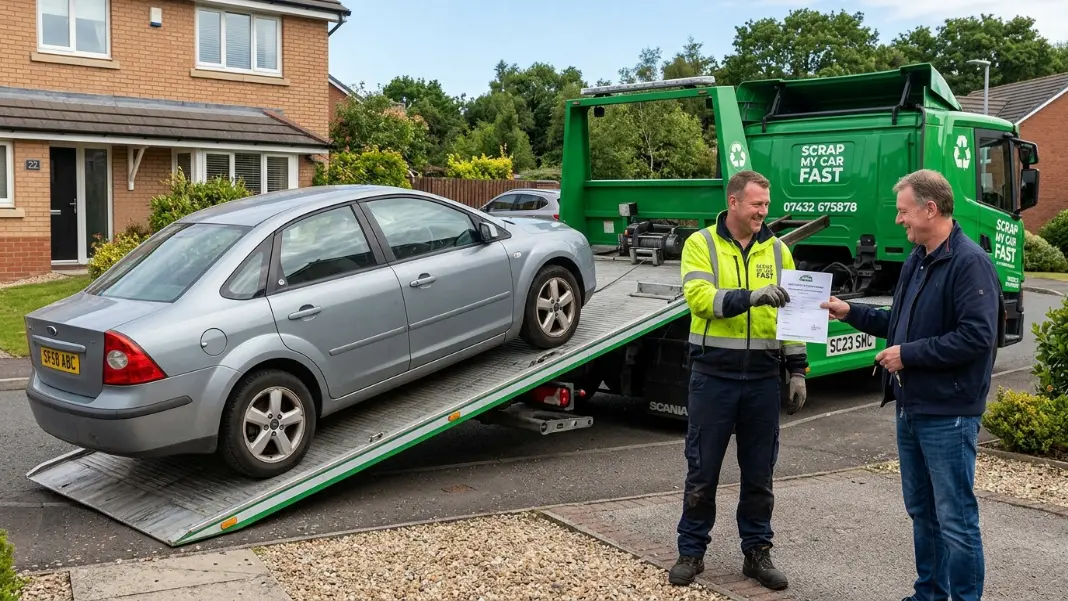
The driver arrives at the agreed time. The process takes around 15 minutes:
- The driver checks the vehicle matches the description given at the time of quoting
- Your ID is checked against the details on file
- You sign the vehicle release form
- You hand over the keys
- The driver loads the vehicle onto the truck
If you have your V5C, the driver will explain how to complete Section 9, the yellow slip you send to DVLA. You do this yourself after collection. Do not hand the full V5C to the driver. Your vehicle is then taken to a licensed Authorised Treatment Facility, the only type of site legally permitted to process an end of life vehicle, worth checking if you’re ever unsure whether a company you’re dealing with is genuinely licensed.
Step 5: Receive Your Payment
Payment goes directly to your bank account by transfer. We do not pay in cash, and legally, no scrap car operator in the UK is allowed to. Under Section 12 of the Scrap Metal Dealers Act 2013, cash payments for scrap metal are a criminal offence, one that applies to the dealer, the site manager, and the individual collection driver personally. Our full explainer on why scrap yards can’t pay cash covers exactly what the law says and how to spot an operator who isn’t complying with it.
Most payments clear the same day as collection. If your collection runs in the afternoon, the transfer typically completes by end of business. There are no deductions from the price quoted.
Step 6: Notify DVLA
This is your legal responsibility, and it is not optional. Until DVLA has processed your notification, their records still show you as the registered keeper, which means you remain liable for any tax demand, parking penalty, or offence connected to the vehicle after it has left your driveway.
If you have your V5C, complete Section 9 and post it to: DVLA, Swansea, SA99 1BD. You should receive written confirmation within 4 weeks. Alternatively, notify DVLA online at gov.uk/sold-bought-vehicle using just the vehicle’s registration number, no logbook needed for the online route.
The penalty for failing to notify is more specific than most guides let on. According to DVLA’s own published enforcement policy, failing to notify a change of keeper or a sale or transfer starts with an out-of-court settlement letter set at £55, reduced to £35 if you pay within 17 days. If that goes unpaid, the case can be pursued through the magistrates’ court, where the maximum penalty rises to £1,000. That escalation path, starting at £35 to £55 and only reaching £1,000 if genuinely ignored, is worth knowing rather than assuming a flat four-figure fine lands immediately.
DVLA will automatically refund any remaining full months of Vehicle Excise Duty to the payment method on file once the notification is processed.
Step 7: You Receive the Certificate of Destruction
Within 7 days of the vehicle being processed at the ATF, you will receive a Certificate of Destruction (CoD). This is issued under the End of Life Vehicles Regulations 2003 and confirms the vehicle has been legally destroyed and removed from DVLA records.
Keep the CoD permanently. It is your proof that you bear no further responsibility for the vehicle, and unlike some other documents, it is worth knowing there is no straightforward reissue process if it goes missing. Once issued, the vehicle’s registration is closed for good too, DVLA’s own position is that these notifications cannot be reversed once made, which is exactly why getting the registration and paperwork right before collection matters more than it might seem. You can verify whether a CoD has been issued against any UK registration using the DVLA vehicle enquiry service at gov.uk.
The CoD is separate from your DVLA notification. You need to do both.
What Happens to Your Car After Collection?
The vehicle goes to an Environment Agency-licensed ATF. The dismantling process follows strict regulations:
- Hazardous fluids are drained and disposed of safely, engine oil, coolant, brake fluid, and fuel
- The battery is removed and sent for specialist recycling
- Catalytic converters, tyres, and any saleable components are removed
- The shell is crushed and transferred to a shredder
- Shredded metal is sorted into ferrous and non-ferrous streams and sent to steel mills
Around 85% of a modern car by weight is recyclable. The steel recovered from end of life vehicles in the UK often re-enters the manufacturing supply chain within six months.
How Long Does the Whole Process Take?
From first contact to money in your account: as little as a few hours with a same-day collection. The quote takes 2 minutes. The collection appointment takes 15 minutes. Payment clears the same day in most cases. The paperwork side runs longer in the background, your Certificate of Destruction arrives within 7 days, and DVLA’s own confirmation of your notification can take up to 4 weeks, but neither of these require any further action from you once you’ve sent Section 9 or completed the online notification.
For a more detailed breakdown of what happens at each stage, see how our scrap car collection process works from first call through to certificate of destruction.
Frequently Asked Questions
Can I scrap a car that is not in my name?
Yes, in some circumstances. If the registered keeper is deceased and you are handling the estate, or if you hold written authorisation from the registered keeper, ATFs can process the vehicle. The documentation required varies by situation, call us before booking to confirm what you need to bring.
Do I need to insure the car before scrapping it?
No. Once you have notified DVLA that the vehicle has been sold or scrapped, you are no longer legally required to keep it insured. Notify your insurer at the same time you notify DVLA to avoid being billed for a renewal on a car you no longer own.
What if my car is an insurance write-off?
We accept Category S, Category N, Category A, and Category B write-offs. If your insurer has settled the claim and returned the vehicle to you at a salvage value, you can scrap it directly. For Cat A and B vehicles, destruction is the legal requirement, scrapping satisfies that. For more on this see our guide to scrapping a written-off car in Manchester.
Can I scrap a SORN car?
Yes. SORN status does not affect eligibility for scrapping. The vehicle does not need to be taxed to be collected. You will still need to notify DVLA separately once collection is complete.
What if my car is on a private road or stuck in a garage?
Let us know when you book. Our drivers work across the M60 corridor and surrounding areas every day and can arrange access for most situations. Private roads and enclosed garage collections happen regularly, just provide the access details when you call.
Will I still get paid if the car is in bad condition?
Yes. Scrap value is based on metal weight, not cosmetic condition. A car with smashed bodywork, no engine, or stripped interior still has material value. The only factor that can reduce the quoted price on the day is if the actual vehicle weight is significantly less than expected due to major missing components.
What if I’ve lost the keys to the vehicle?
Let us know when you book rather than on the day. In most cases a non-runner or locked vehicle can still be collected using a flatbed, though access to the boot and interior for a final check may be limited. It’s worth checking whether a locksmith or dealer can cut a replacement key first if the vehicle is otherwise straightforward to move.
Can I still keep my number plate if I’ve already booked a collection?
Only if the DVLA retention process is completed before the driver arrives. Once a vehicle has been through an ATF and a Certificate of Destruction has been issued, the registration cannot be recovered under any circumstances. If you haven’t started the retention process yet, it’s worth pausing your collection date until it’s done rather than risking the plate.
Ready to get your price? Use our free online quote form or call us directly. We collect scrap cars across Manchester and Salford, and the rest of Greater Manchester, with same-day slots available. If anything about the process still isn’t clear, our FAQs page covers the other questions people ask most often before booking.