
Getting a quote to scrap your car should be one of the easier things you do this week. Type in your registration, add your postcode, answer a couple of questions about the car’s condition, and you have a number. The whole process should take under two minutes.
But here is the thing: that number is not always what you will actually receive on collection day. And the gap between what was quoted and what gets paid is often not small. Understanding why that gap exists and how to avoid it is worth ten minutes of your time before you book anything.
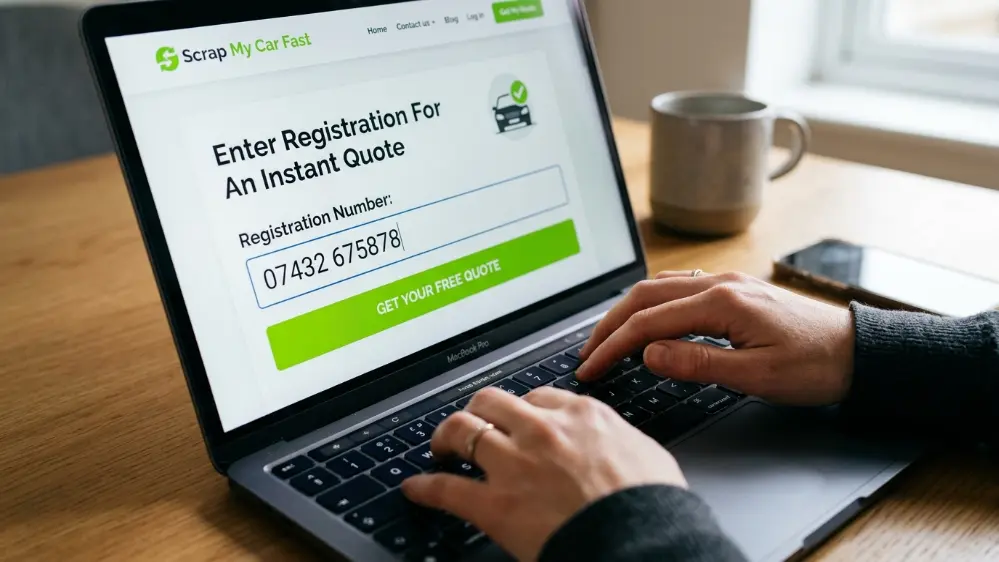
How an Instant Quote Actually Works
When you enter your registration number on a scrap car platform, the system runs it through the DVLA database and pulls back the vehicle’s make, model, fuel type, engine size, and year. It cross-references that data against the vehicle’s known kerb weight and applies the current scrap metal rate.
The output is a base metal value, adjusted for known factors like the likely presence of a catalytic converter and regional collection logistics. The whole calculation happens automatically, which is why genuine instant quotes are possible.
This process is accurate as long as the vehicle matches its registration record. If your car has been significantly modified, has had the catalytic converter removed, or is substantially incomplete, the instant figure will be higher than what the buyer will confirm once they see the vehicle.
A legitimate buyer will clearly state that the quote is based on the car being as described. If you accurately describe your car’s condition when you enquire, the price you are quoted should be the price you are paid.
The Difference Between a Firm Quote and an Estimate
This distinction matters enormously and is where a lot of frustration in the scrap car market comes from.
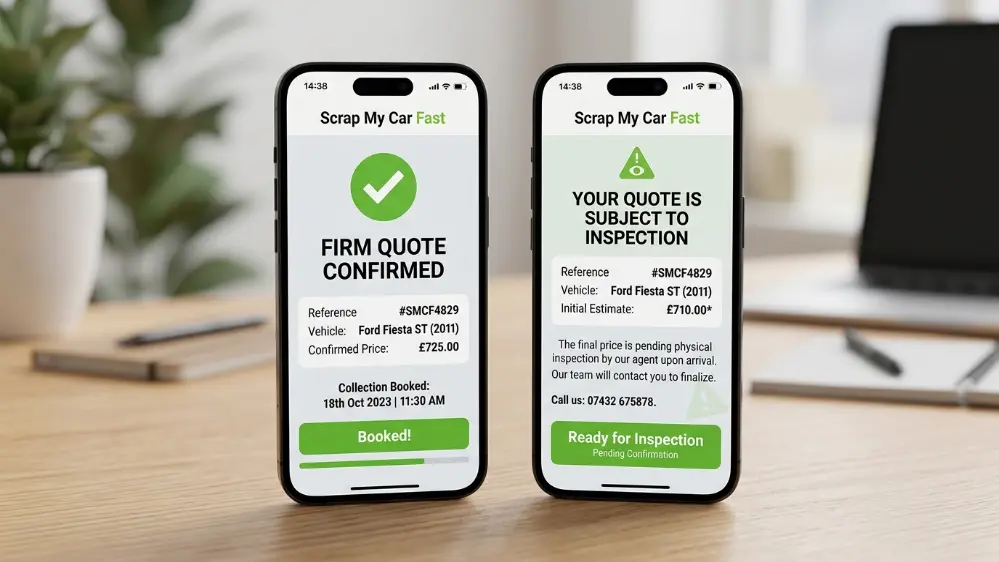
A firm quote is a specific price offered on the basis of your vehicle registration and a brief condition description. It should not change on collection day unless you actively misrepresented the car for example, saying it starts when it does not, or failing to mention that the catalytic converter has been removed.
An indicative quote or estimate is a figure that is subject to the buyer physically inspecting the vehicle. In practice, this almost always means the price goes down on the day, not up.
When you are comparing quotes, the first question to ask about any figure you receive is whether it is firm or subject to inspection. Do not accept an inspection-based quote if other buyers are offering firm prices, because you have no real guarantee of what you will receive until the truck is outside your house.
For a deeper look at how quotes are structured and what the language used by different platforms actually means, our post on how to compare and get the best scrap car quote covers this in detail.
Hidden Costs That Reduce the Amount You Actually Receive
Beyond the firm-versus-estimate issue, there are a few specific charges that reduce the real payout and are not always obvious when you first see a quote.
Collection fees. Some buyers quote the vehicle value and then add a collection charge on booking. On a smaller or older car where the scrap value is modest, a £30 to £50 collection fee is a significant percentage of the total. Always confirm whether collection is included in the price before comparing figures.
Distance surcharges. Some national platforms charge extra if you are outside their standard collection zone. This tends to affect people in suburban or semi-rural parts of Greater Manchester more than those in the city centre. A local buyer without this overhead will usually be more competitive.
Parts deductions. If the buyer arrives and identifies missing components a battery, a spare wheel, a catalytic converter they will often deduct the value of those parts from the agreed price. This is legitimate if parts are genuinely absent, but it is used dishonestly by some operators to reduce the payout on cars that were described accurately. If you have an intact, complete vehicle, insist on the original quoted price.
Same-day or next-day fees. A small number of platforms charge a premium for fast collection. A reputable local buyer should be able to offer same-day or next-day collection without an additional charge. If a platform is trying to charge you for speed of service, look elsewhere.
What to Have Ready Before You Get a Quote
Getting an accurate quote is faster and more reliable if you have a few things to hand:
Your vehicle registration number. This is the most important piece of information. The system will pull the vehicle details automatically from the DVLA database.
Your postcode. Collection costs are priced regionally. Your postcode helps the buyer calculate a locally accurate quote rather than a national average.
An honest description of the car’s condition. Is it a runner? Is there body damage? Has anything been removed? You do not need to be exhaustive, but being accurate protects you from price changes on collection day.
Your V5C logbook or knowledge of whether you have it. You do not need a V5C to scrap a car in the UK, but buyers will want to know upfront if it is missing. Our guide to scrapping a car without a V5 logbook explains exactly how the process works without one.
How Many Quotes Should You Get?
Three is a reasonable number. Fewer than that and you might be leaving money on the table. More than that and you are spending significant time for diminishing returns.
The variation between legitimate local buyers tends to be in the £30 to £80 range for a typical family car. That is a meaningful difference worth five minutes of comparison, but it is not a reason to spend an afternoon contacting a dozen platforms.
What produces the biggest spread in quotes is comparing local, direct buyers against national broker platforms. National platforms often show headline figures that include a broker margin the actual buyer doing the collection is receiving less than the headline quote, and the service often reflects that. A direct local buyer cutting out that margin can frequently offer a better price and more straightforward service.
Red Flags to Watch For
A few things that should make you pause before accepting a quote:
The price drops significantly on the day. A genuine buyer with a firm quote will not reduce the price on collection unless there are real discrepancies with what was described. If a driver arrives and immediately starts identifying reasons to pay less, this is a tactic, not an accurate assessment.
The platform is not a licensed ATF. Only an Authorised Treatment Facility can legally issue a Certificate of Destruction, which is the document that removes the car from your name with the DVLA. If you scrap a car through an unlicensed operator, you may not receive a CoD and could remain technically liable for the vehicle. Always confirm ATF status before proceeding. Our post on what an Authorised Treatment Facility is explains this in full.
No confirmation of price in writing. A legitimate buyer will confirm the price to you in writing by email or text before collecting. If the only confirmation is a verbal conversation, that is a risk.
Pressure to book immediately. Legitimate buyers do not need to create urgency. If someone is telling you the price expires in an hour or that they have another buyer lined up, that is a pressure tactic, not a reflection of how the scrap market works.
Getting the Best Result
The simplest approach: get two or three quotes from licensed local buyers, compare the firm prices (not the estimates), confirm collection is included at no extra charge, and book with whoever offers the most on a firm basis.
For Greater Manchester, you can get an instant quote from us right now the price is generated immediately, it is firm, and collection across Manchester, Salford, Stockport, Bolton, Bury, Oldham, Wigan, Rochdale, and the surrounding areas is included at no extra charge.
If you want to understand what a fair price looks like for your specific car before you start comparing, our scrap car value guide for Manchester will give you that context.