
If a scrap yard or a “we’ll pay cash” collection driver offers you notes on your doorstep for your car, they are breaking the law. Under Section 12 of the Scrap Metal Dealers Act 2013, it is a criminal offence for any scrap metal dealer in England and Wales to pay for a vehicle in cash, no matter how small or large the amount. Payment must be made by bank transfer or a non-transferable cheque instead.
That is the short answer. The longer answer, why the law exists, who it actually applies to, what happens if a dealer breaks it, and how to tell whether the company collecting your car is complying with it, is worth understanding properly before you accept any quote.
What Section 12 of the Scrap Metal Dealers Act Actually Says
The Scrap Metal Dealers Act 2013 replaced an older, weaker law from 1964 that had done little to stop a surge in metal theft across the UK, including catalytic converter theft, stripped copper cabling and stolen vehicles being broken down for parts within hours of being reported missing. Section 12 of the Act is the specific clause that bans cash payments outright.
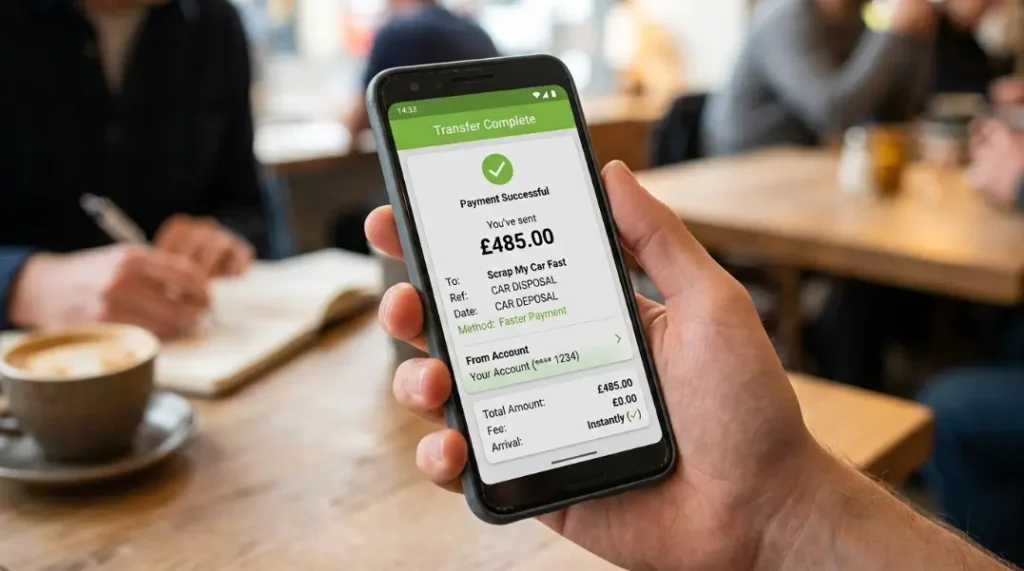
The rule is simple: a scrap metal dealer may only pay for scrap metal, and a car counts as scrap metal once it is being sold for its recycling value, by a non-transferable cheque or by electronic transfer of funds. That covers BACS, Faster Payments, and standard bank transfers. It does not cover cash, and it does not cover a transferable cheque that could be cashed by someone other than the seller.
According to GOV.UK’s own supplementary guidance on the Act, there are no exemptions to this rule. It does not matter whether the car is worth £80 or £800. It does not matter whether the seller would prefer cash. The law does not allow for it under any circumstance.
Who Actually Gets Prosecuted If Cash Changes Hands
This is the part most articles on this topic skip, and it matters if you use a collection service rather than driving your car to a yard yourself.
The offence does not just apply to the scrap yard itself. GOV.UK’s guidance is explicit that it also applies to the collection company acting on the dealer’s behalf, and to the individual driver who physically hands over the payment. If a collection driver turns up at your house and pays you in cash, that driver, the collection company, and the scrap metal dealer they are working for can all be prosecuted separately for the same transaction.
This is worth knowing because most people picture “the scrap yard” as one entity. In practice, a lot of scrap car collection in Greater Manchester works through a driver coming to your address rather than you delivering the vehicle yourself. The law was written with exactly that scenario in mind, which is why it reaches the driver directly rather than only the business that employs them.
Why This Law Exists
Metal theft cost the UK economy an estimated £770 million a year before the Act came into force. Copper cabling, lead from church roofs, and catalytic converters were being stripped and sold to scrap dealers within hours, often for cash, with no paper trail and no way to trace who had sold what. Cash payments made stolen metal effectively untraceable the moment it changed hands. Catalytic converter theft in particular became so common in the years leading up to the Act that entire vehicles were being targeted purely for the platinum group metals inside a single component, sometimes stolen from a driveway in under two minutes.
Section 12 closes that loophole. Every payment must now go through a bank account belonging to a named, identifiable person. If stolen metal, or a stolen vehicle, is found to have passed through a scrap dealer, investigators can follow the bank transfer back to exactly who was paid and when. That traceability is the entire point of the law, not a side effect of it.
What Legal Payment Actually Looks Like
If you are getting a genuine quote from a licensed operator, the payment method should be one of these two, and nothing else:
Electronic bank transfer. This includes BACS, Faster Payments, and standard online banking transfers. Same-day bank transfer is the payment method almost every properly licensed scrap car service in the UK uses, because it is fast, fully traceable, and satisfies the law without any ambiguity.
A non-transferable cheque. Under Section 81A of the Bills of Exchange Act 1882, this means a cheque made out specifically to you and marked as non-transferable, so it cannot be cashed by anyone else. In practice, almost no operator uses this route anymore because bank transfer is faster and simpler for everyone involved.
Cash is not on that list under any circumstances, and nothing your collection driver says on the doorstep changes that. If your quote was agreed at a fixed price, that exact amount should land in your account the same day, by transfer, not handed over as notes.
What the Penalties Actually Are
This is not a minor administrative rule with a slap-on-the-wrist fine attached. Under Section 12, anyone found guilty is liable on summary conviction to an unlimited fine. GOV.UK’s guidance specifically confirms that a collection company paying cash on a dealer’s behalf, and the scrap metal dealer subcontracting them, can each face an unlimited fine separately for the same offence.
Beyond the direct fine, a scrap metal dealer convicted under the Act risks having their local council licence revoked entirely, meaning they can no longer legally trade at all. For a business built on repeat local trade and word of mouth, that is often a far more serious consequence than the fine itself.
Cash Isn’t the Only Requirement, It’s Paired With ID Checks
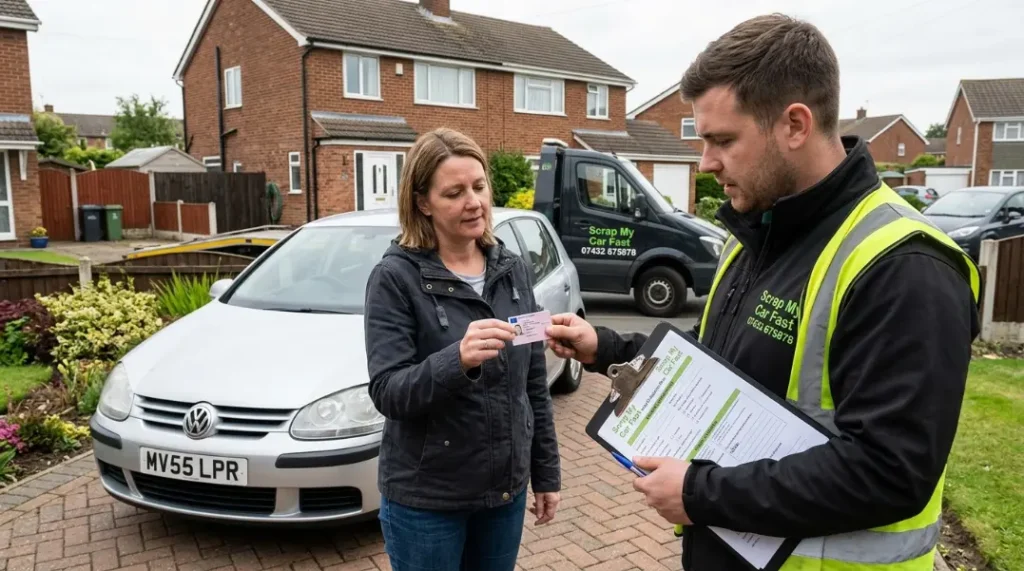
The cash ban does not exist in isolation. The same Act requires every scrap metal dealer to verify and record the identity of the person selling the vehicle before any payment is made. In practice, that means a valid driving licence or passport is checked on the day of collection, alongside the traceable payment.
Together, the two requirements exist for the same reason: to make every transaction traceable to a real, identifiable person on both ends. The same logic applies even if you have lost your paperwork, our guide on scrapping a car without a V5C logbook explains how ID verification still has to happen even when the vehicle documents are missing. If you have read our guide on what happens when you scrap a car in Manchester, you will have seen ID checks mentioned as a standard part of collection day. This is the law behind why that step exists, not an optional extra some companies choose to add.
How to Spot an Operator Who Isn’t Complying
A cash offer is the clearest single warning sign you can get, but it is rarely the only one. If an operator is willing to break Section 12 to win your business, it is worth asking what else they might be cutting corners on.
- They offer cash on the phone before even seeing the car. A legitimate quote is based on your registration and current scrap metal rates, not a negotiation tactic to get you to accept quickly.
- They cannot confirm they work with a licensed Authorised Treatment Facility. Cash payment and unlicensed vehicle destruction often go hand in hand, since both cut the same corners for the same reason. Our guide on what an Authorised Treatment Facility actually is explains why this matters just as much as the payment method.
- They don’t ask for ID. If a driver arrives and doesn’t check your driving licence or passport, that is a second Section 12-adjacent requirement being skipped, not a courtesy being extended.
- They avoid giving a straight answer about payment timing. “We’ll sort you out” is not the same as “bank transfer, same day, before we leave.”
If any of these apply, you are not looking at a small paperwork shortcut. You are looking at an operator who may not hold a valid licence at all.
What to Do If You’re Offered Cash
If a collection driver or scrap dealer offers you cash, you are within your rights to decline and ask for bank transfer instead. Any operator running a legitimate, licensed business will have no issue with this, since it is simply how they are legally required to pay you anyway.
If they push back or cannot arrange a transfer, that is worth treating as a serious red flag rather than an inconvenience. You can report a scrap metal dealer you suspect is operating illegally to your local council’s licensing department, since councils are the licensing authority for scrap metal dealers under the Act. Greater Manchester residents can also flag concerns to Greater Manchester Police’s non-emergency line if there is a suspicion the vehicle itself may not be legitimately owned by the seller offering it. If you would rather talk through a quote or a concern before booking anything in, you can also get in touch with our team directly.
How This Works When You Book With Us
We collect vehicles across Salford, Manchester and the rest of Greater Manchester with a fixed process on this exact point: your quote is agreed before collection, and payment goes to your bank account by transfer on the day your car is collected. No cash changes hands at any point, and no driver is authorised to offer it. That is not a policy choice we made for marketing purposes, it is what Section 12 requires of us as a matter of law, and it is the same requirement every properly licensed operator in the region has to follow, regardless of what they advertise on the side of their van.
If you want to see the full collection process from quote to payment, our step-by-step guide to how it works covers exactly what happens on the day, including the ID check and the payment transfer itself. For an idea of what your specific vehicle might be worth before you book anything in, our current scrap car prices page is a useful starting point, and if anything about the process still isn’t clear, our FAQs page covers the other questions people ask most often before booking a collection.
Frequently Asked Questions
Is it illegal to sell a scrap car for cash in the UK?
Yes. Under Section 12 of the Scrap Metal Dealers Act 2013, it is illegal for a scrap metal dealer to pay you cash for a vehicle sold for scrap. Payment must be made by bank transfer or a non-transferable cheque instead, with no exceptions regardless of the amount involved.
What happens if a scrap yard pays me in cash?
The scrap yard, and anyone who physically made the cash payment on the dealer’s behalf, such as a collection driver, is committing a criminal offence under Section 12. As the seller, you are not the one breaking the law, but accepting cash is a strong signal the operator is not properly licensed and may be cutting corners elsewhere in the process too.
Can I ask for cash if I prefer it?
No. It does not matter whether you would prefer cash. A licensed scrap metal dealer is legally prohibited from paying you in cash under any circumstance, so any operator offering it is not complying with the law regardless of who requested it.
Does this law apply to private sales too, or only scrap dealers?
Section 12 specifically applies to scrap metal dealers, which includes anyone licensed to buy vehicles for their scrap or salvage value, including motor salvage operators and mobile collection services. It does not apply to a private sale between two individuals where the car is still roadworthy and being sold as a working vehicle rather than for scrap.
How is the payment actually made when I scrap my car?
Licensed scrap car operators pay by electronic bank transfer, typically the same day the vehicle is collected. You provide your bank details when you accept your quote, and the agreed amount is transferred once the vehicle has been collected and the paperwork, including your Certificate of Destruction, has been completed.
What should I do if I think a scrap dealer is operating illegally?
Report your concerns to your local council’s licensing department, since councils act as the licensing authority for scrap metal dealers under the Act. If you have handed over a vehicle to an operator who cannot confirm they work with a licensed Authorised Treatment Facility, it is also worth checking the Environment Agency’s public register to confirm whether the destruction site is genuinely licensed.