
Your scrap car quote comes from one simple sum: your car’s weight in tonnes, multiplied by the current price per tonne for scrap steel, plus a bit extra if your catalytic converter is still fitted, minus a deduction for anything missing. That’s it. There’s no secret formula and no mystery behind the number, and once you know it, you can roughly check your own quote yourself rather than just trusting whatever figure you’re given.
This guide walks through that formula with real worked examples, so you can see exactly how a number like £245 or £410 actually gets produced. If you’d rather understand why prices move up and down over time instead, our separate guide on what’s driving UK scrap car rates in 2026 covers the market side of things. This one is about the maths behind any single quote.
The Formula Itself
Weight (in tonnes) × current price per tonne = base scrap value
Add catalytic converter value if fitted and working. Subtract a deduction for any major missing components. What’s left is roughly what you should expect.
Every licensed operator in the UK is working from the same basic equation. What changes from one quote to the next isn’t the formula, it’s the numbers going into it: the exact weight of your specific car, today’s metal rate, and the condition of the vehicle in front of the driver.
Step 1: Find Your Car’s Weight
Scrap value is priced by tonnage, so the first number you need is your car’s kerb weight in kilograms, divide by 1,000 to get tonnes. You’ll find this in your car’s handbook, on the manufacturer’s website, or on your V5C logbook under section D.1 (the technical weight fields), listed as the vehicle’s revenue weight or mass in service depending on the exact wording your logbook uses. If you no longer have easy access to the V5C itself, a quick search for your exact make, model and year alongside “kerb weight” will usually turn up the manufacturer’s own published figure within a couple of minutes. If you can’t find it easily, a rough guide by vehicle type gets you close enough to sanity-check a quote:
| Vehicle type | Typical kerb weight |
|---|---|
| Small hatchback (Fiesta, Corsa, 500) | Under 1,050 kg |
| Medium car (Focus, Astra, Golf) | 1,100–1,350 kg |
| Large car or estate | 1,400–1,700 kg |
| SUV or 4×4 | 1,600–2,100 kg |
| Large SUV or van | Over 2,000 kg |
Step 2: Apply Today’s Metal Rate
Scrap steel in the UK has traded roughly between £130 and £210 per tonne over the past 18 months, moving with the global steel market. There’s no single fixed number, it changes weekly, sometimes by a meaningful amount, which is exactly why a quote from three months ago won’t match what you’d get today.
Multiply your car’s tonnage by wherever that rate currently sits. A 1.2 tonne car at £170 a tonne gives you a base figure of £204. That’s before anything else is added or taken off.
Step 3: Add Catalytic Converter Value
If your car’s catalytic converter is still fitted and hasn’t been targeted for theft, it adds a meaningful amount on top of the base steel calculation, because the platinum, palladium and rhodium inside are worth far more per gram than steel. The exact addition varies with precious metal prices and the specific converter, but on a mid-size car this typically adds £30 to £100 on most cars, more on larger vehicles with bigger catalytic units.
Step 3.5: Other Non-Ferrous Metal in the Car
Steel makes up most of a car’s weight, but it isn’t the only metal a buyer recovers. Aluminium, found in some bonnets, wheels, and increasingly in engine blocks on newer cars, and copper, mainly in wiring looms and electric motors, both trade at a significantly higher rate per tonne than standard steel. Neither adds up to much by weight compared to the steel shell, so this isn’t a separate line item most quotes break out individually, but it’s part of why the same weight-times-rate maths on two cars of similar tonnage can still land slightly differently depending on how much aluminium or copper each one actually contains.
Step 4: Subtract for Missing Parts
If major components are missing, an engine, gearbox, catalytic converter, or alloy wheels, that reduces the final figure, because the buyer can’t recover the value of parts that aren’t there. As a rough guide, a vehicle missing a major mechanical component like an engine or gearbox typically sees the quote reduced by somewhere in the region of 10 to 30%, depending on what’s gone and how much of the car’s total weight it represented.
Worked Examples by Weight Category
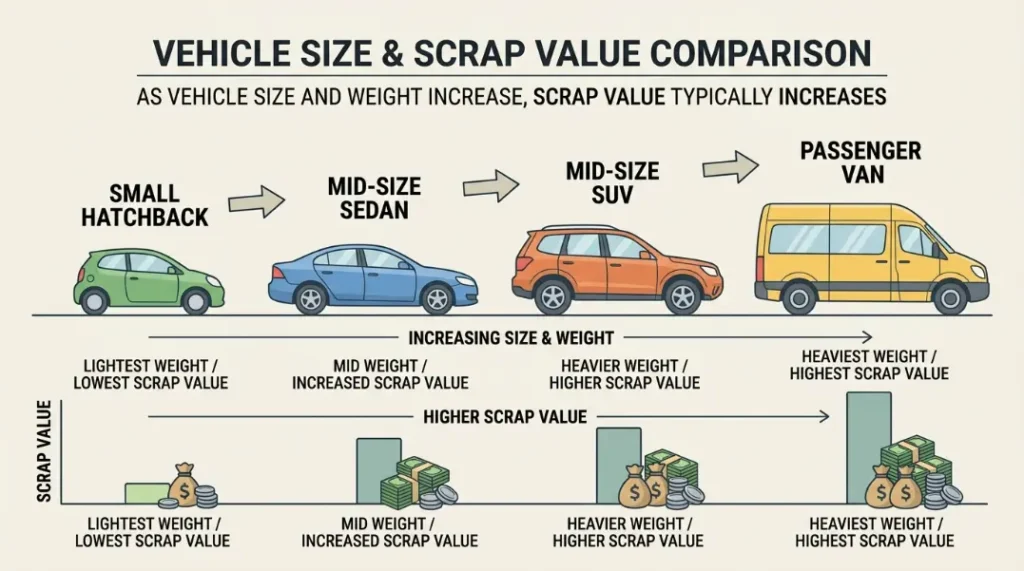
Here’s how the formula plays out across different vehicle sizes, using a mid-range steel rate of £170 per tonne and a complete, working vehicle in each case:
| Category | Weight | Base (weight × rate) | With cat converter | Typical range |
|---|---|---|---|---|
| Small hatchback | 1.0 tonne | £170 | £190–£210 | £145–£210 |
| Medium car | 1.2 tonnes | £204 | £230–£260 | £195–£275 |
| Large car/estate | 1.55 tonnes | £264 | £300–£340 | £255–£360 |
| SUV/4×4 | 1.85 tonnes | £315 | £360–£420 | £310–£460 |
| Large SUV/van | 2.3 tonnes | £391 | £440–£520 | £390–£580 |
These figures line up with the current price bands we quote for Greater Manchester, and the small gap between the raw calculation and the quoted range accounts for non-ferrous content beyond the catalytic converter, aluminium trim, copper wiring, that a straightforward weight-times-rate sum doesn’t fully capture on its own.
Why Two Identical-Looking Cars Can Get Different Quotes
If you’ve compared quotes and found two seemingly identical cars valued differently, it’s rarely a sign one buyer is lowballing you. The formula is the same everywhere, but each input can differ:
The metal rate moves weekly. A quote taken on a Monday might reflect a slightly different per-tonne rate than one taken the following week, particularly during periods of steel market volatility.
Collection logistics get baked in. A buyer operating in a dense urban area like Greater Manchester has lower collection costs per vehicle than one covering a rural route, and that efficiency can show up as a marginally better quote.
“Firm” versus “indicative” quotes aren’t the same thing. A firm quote based on your registration should hold on collection day. An indicative or estimated quote can be revised down once the vehicle is actually inspected, which is a different thing entirely from a fair quote simply reflecting a lower metal rate that week.
A Real Scenario, Start to Finish
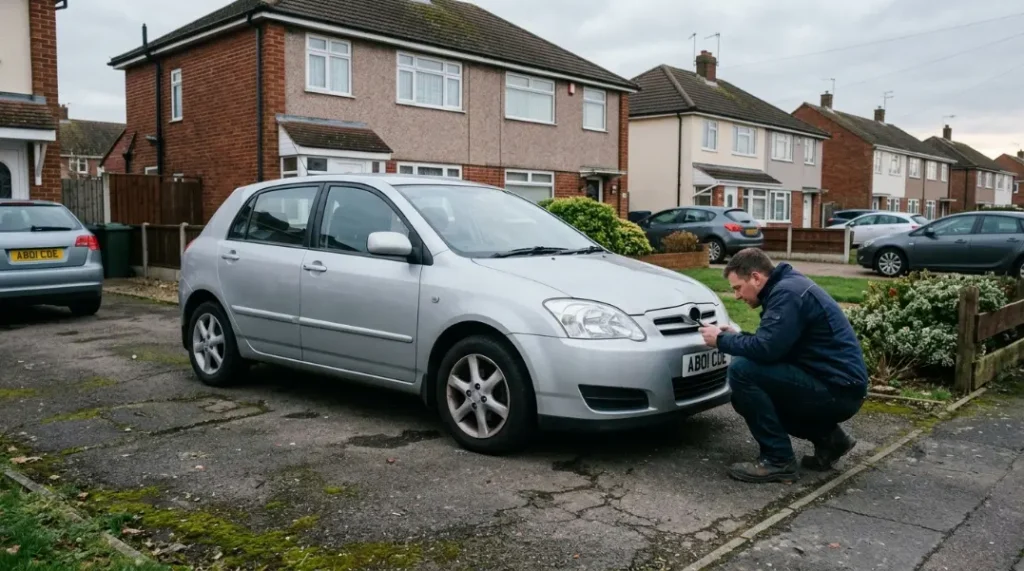
Say you’ve got a 2011 Vauxhall Astra, roughly 1.3 tonnes, parked on a driveway somewhere across Greater Manchester. The steel rate that week sits at £165 a tonne. The base calculation is 1.3 × £165, which comes to £214.50. The catalytic converter is still fitted and working, adding roughly £50 to £70 depending on current precious metal prices, bringing the total to somewhere around £265 to £285. Nothing major is missing, so there’s no deduction to apply. That’s the number a genuine quote should land close to, and it’s the same maths whether the quote comes from a large national platform or a local Manchester operator, the only difference being who absorbs more or less of the collection cost before passing the final figure to you.
How to Use This to Check Your Own Quote
You don’t need to trust a number blindly. Find your car’s kerb weight, convert it to tonnes, and multiply by a current per-tonne steel rate (a quick search for “UK scrap metal price per tonne” gets you a reasonable current figure). If your quote sits meaningfully below that base calculation with no obvious reason, missing parts, extensive damage, it’s worth asking the buyer to explain the gap directly rather than just accepting it. A legitimate operator should be able to walk you through their number the same way this guide just has.
If you’d rather skip the maths entirely, our scrap car calculator applies the current rate to your specific registration automatically, and the instant quote you receive is firm, not an estimate that changes on collection day.
What This Doesn’t Cover
This formula explains scrap value specifically, what your car is worth for its metal and recoverable components once it’s genuinely being scrapped. It’s a different calculation from what you’d get selling a roadworthy car privately or through part-exchange, where condition, mileage, and market demand matter far more than weight. If you’re weighing up scrapping against selling, our comparison of scrap vs part exchange vs private sale covers which route actually makes sense for a car that’s still driveable.
It’s also worth remembering that scrap value and a Certificate of Destruction are two separate things entirely, getting a fair price doesn’t depend on paperwork, but making sure the vehicle is properly deregistered afterwards does. Our guide on what a Certificate of Destruction actually confirms covers that side of the process.
Frequently Asked Questions
What is the current price of scrap metal per tonne in the UK?
Scrap steel has traded roughly between £130 and £210 per tonne over the past 18 months, and it moves with the global steel market rather than sitting at a fixed rate. For an accurate current figure applied to your specific vehicle, an instant quote based on your registration is more reliable than any published average.
Does a car’s condition affect its scrap price if it’s being weighed by metal content?
Yes, but only in specific ways. Cosmetic condition, dents, scratches, interior wear, doesn’t affect scrap value at all, since it’s based on weight and metal content, not appearance. What does matter is whether major components are physically present. A car missing its engine, catalytic converter, or wheels is genuinely lighter in recoverable material, which is reflected in a lower quote.
Why is my catalytic converter worth so much more than the rest of the car by weight?
Catalytic converters contain small amounts of platinum, palladium and rhodium, precious metals that are worth substantially more per gram than the steel making up the rest of the vehicle. A component that weighs only a kilogram or two can add a meaningful chunk to your total quote purely because of what’s inside it, independent of the car’s overall weight.
Can I calculate my own car’s scrap value accurately at home?
You can get a reasonable estimate using the formula in this guide, your car’s weight, the current per-tonne rate, and an allowance for the catalytic converter. It won’t be exact, since factors like non-ferrous content and specific market conditions vary, but it gives you a solid figure to compare against any quote you’re offered.
Do heavier cars always get higher scrap quotes than lighter ones?
Generally yes, since weight is the primary driver of scrap value. But condition matters enough to occasionally reverse this: an older, heavier car with a working catalytic converter and no missing parts can out-value a newer, lighter car that’s missing its cat or major components, even though the newer car might look like the better vehicle.
Why do quotes from different companies vary for the exact same car?
Because each operator is applying the same formula to slightly different inputs. The metal rate they’re working from that day, their collection costs for your specific location, and whether their quote is firm or subject to inspection on the day can all shift the final number. A £30 to £50 difference between two genuine quotes on the same car is normal and usually reflects one of these factors rather than either quote being wrong.
Want an exact figure rather than an estimate? Get your instant quote here, based on your registration and today’s rates, with no obligation.