
If you have been Googling this question for the last twenty minutes and landed on six different sites that all gave you a number without explaining where it comes from, you are not alone. Scrap car pricing is one of those things that looks simple on the surface someone tells you a number, you either accept it or you don’t but there is actually quite a lot happening underneath.
This post is not going to give you a magic number, because there isn’t one. What it will give you is the framework to understand exactly what your car is likely to be worth, what pushes that figure up, what pulls it down, and why the same car can get wildly different quotes from different buyers on the same day.
The Short Answer First
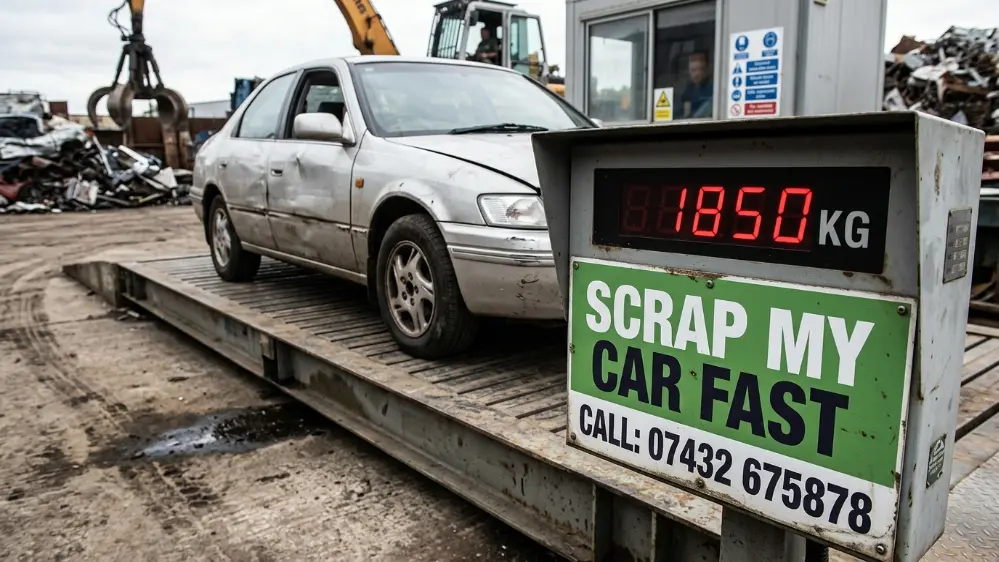
Most private cars scrapped in the UK in 2026 are fetching somewhere between £150 and £450. That is a wide range, and the position your car lands in depends almost entirely on two things: how much it weighs and what scrap metal is currently trading at.
Small city cars your Fiat 500s, Ford Kas, Vauxhall Corsas typically come in at the lower end of that bracket. Large family cars, SUVs, and 4x4s sit toward the top. Vans, which we cover separately in our guide to scrapping a van in Manchester, tend to pay more than cars of comparable age simply because there is more metal in them.
Here is a rough guide by vehicle category based on current 2026 conditions:
| Vehicle Type | Typical Scrap Weight | Approximate Value |
| Small city car (e.g. Fiat 500, VW Polo) | 900 1,050 kg | £150 £220 |
| Medium hatchback (e.g. Ford Focus, VW Golf) | 1,100 1,350 kg | £200 £280 |
| Large saloon / estate (e.g. BMW 5 Series, Volvo V70) | 1,400 1,700 kg | £260 £360 |
| SUV / 4×4 (e.g. Toyota RAV4, Land Rover Freelander) | 1,600 2,100 kg | £310 £450 |
| Large SUV / pickup (e.g. Range Rover, Ford Ranger) | 2,000 2,800 kg | £400 £580 |
These are honest estimates. Anyone who quotes you a specific number before knowing your registration, postcode, and exact model spec is guessing.
Why Weight Is Everything
Scrap buyers purchase your car by the tonne. They are not buying a car they are buying steel, aluminium, and copper that happens to be assembled in the shape of a car. The current steel scrap price in the UK fluctuates with global demand, typically landing somewhere between £130 and £210 per tonne depending on the month and market conditions.
Your car’s kerb weight, which you can find on the V5C or by searching the model specification online, is the starting point for every calculation. A buyer will weigh the vehicle on arrival and pay based on that figure against the day’s metal rate.
This is why a tatty 2006 BMW 5 Series with 200,000 miles on the clock can be worth more as scrap than a pristine 2009 Fiat 500 with a full service history. The BMW is simply a heavier car carrying more metal.
What Else Affects the Price?
Weight drives the base figure, but there are a few things that can move it meaningfully in either direction.
Catalytic converter condition
If your car has a catalytic converter and it is still in good working order, it adds value. Catalytic converters contain small amounts of platinum, palladium, and rhodium metals that trade at significant premiums. A working cat on a larger-engined car can add £30 to £100 to your quote depending on the vehicle.
If your cat has already been stolen which is unfortunately common on certain Toyota, Honda, and Lexus models your scrap price will reflect that absence.
Fuel type
Diesel cars generally weigh more than their petrol equivalents because of the heavier engine architecture, which works in your favour on scrap. Electric and hybrid vehicles are a separate conversation because of battery disposal requirements, which we cover in a later guide.
Location
Scrap buyers price in their collection distance. If you are in central Manchester or Salford, a local operator like Scrap My Car Fast will often be able to offer more than a national broker who subcontracts collection at additional cost. This is one of the reasons why getting quotes from local, direct buyers rather than price comparison aggregators often produces a better result.
Whether the car is complete
If parts have been removed wheels, battery, seats, catalytic converter most buyers will deduct the value of those components from the quote. A stripped shell is worth less than a complete car because the buyer cannot recover the value of those missing parts at the recycling stage.
How Scrap Car Prices Are Set Day to Day
The UK scrap metal market moves with global steel prices, which are influenced by demand from China, energy costs, and the wider commodities market. In practical terms, this means scrap car prices can shift by £10 to £30 in either direction week to week.
This is worth knowing because it explains why a quote you received three months ago might not reflect what you would get today. It also explains why the number you see on an aggregator website at 9am on a Monday might differ from what a local buyer offers you on the phone later that afternoon.
We publish a regularly updated breakdown of current scrap car prices in our scrap car prices Manchester guide so you can cross-reference any quote you receive against realistic current market values.
The Difference Between a Firm Quote and an Opening Offer
This is important, and it catches people out more often than it should.
Some buyers particularly national brokers and aggregator platforms give you a headline figure designed to get you to book. The actual payment on collection day can be lower, sometimes significantly, with deductions applied for things like “missing parts,” “excessive rust,” or “collection surcharge.”
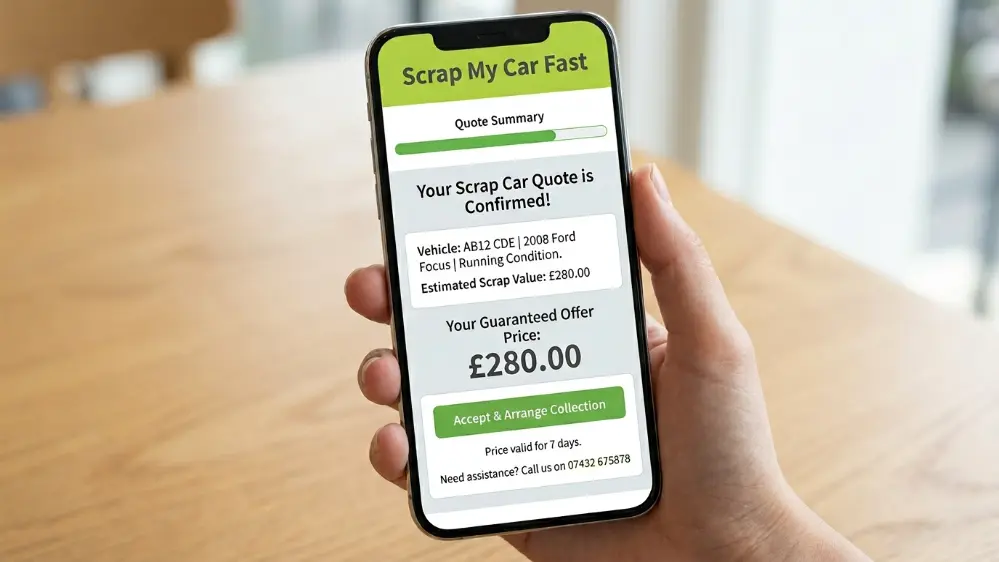
A legitimate operator will give you a firm quote based on your registration and a brief description of the car’s condition. That figure should not change on collection day unless you described the car inaccurately. If a buyer needs to physically inspect the vehicle before confirming the price, that is not an instant quote it is an estimate.
For a detailed breakdown of how the quoting process actually works and what to watch for, our post on how to compare and get the best scrap car quote covers this in full.
So How Do You Make Sure You Get the Best Price?
A few things that genuinely move the needle:
Get at least two or three quotes. Not because every buyer is dishonest, but because pricing varies enough that a ten-minute comparison exercise can be worth an extra £40 to £80. Our guide on how to get the best scrap car price goes through this in detail.
Don’t remove parts before you enquire. You might think a set of decent alloys is worth pulling off and selling separately, and sometimes that is true. But if you strip the car and then ask for a scrap quote, the buyer will price the absence of those wheels into their offer. Work out the numbers on both options before you touch anything.
Be accurate about condition. If the car does not start, say so. If there is significant body damage, mention it. Giving an accurate description upfront means the quote you receive is the quote that holds on collection day. Surprises on the day nearly always go in the buyer’s favour.
Use a local ATF rather than a national aggregator. An Authorised Treatment Facility operating locally carries lower overheads on collection and does not need to pay a middleman, which often means a better price passed on to you. You also get the legal protection of a proper Certificate of Destruction issued on the day.
A Note on Cars That Are Not Running
One question that comes up a lot: does a non-runner car get paid less than one that drives?
Generally, no not significantly. The scrap value is about the metal, not the drivability. A car that will not start is collected on a flatbed or by winch and weighed just the same as one that drives onto the truck. You should not accept a major reduction in price simply because the car is not mobile.
If someone is trying to cut your quote by £100 because the car will not start, that is a red flag. Collection costs for a non-runner are modest and should not translate into a significant price difference. We cover this in more detail in our post on getting a broken or non-running car collected for scrap in Manchester.
The Bottom Line
Scrap car values in 2026 are driven by weight and the steel market, tweaked by catalytic converter condition and location. Most family cars will earn you somewhere between £195 and £360, with heavier vehicles sitting above that and small city cars below.
The gap between the best and worst quotes you will receive for the same car can easily be £50 to £100, which is reason enough to spend ten minutes comparing. Use a licensed ATF, get a firm rather than indicative quote, and do not strip parts before you enquire.
If you want to know exactly what your car is worth right now, you can get an instant quote here it takes about 60 seconds and the price is fixed, not estimated.