
Most people who scrap a car accept the first quote they see. That is understandable. The process feels unfamiliar, the numbers seem fixed, and the differences between buyers look marginal on the surface. But the scrap car industry has enough variation between buyers, enough unlicensed operators willing to cut corners, and enough avoidable mistakes that knowing what to do and what not to do genuinely changes what you walk away with.
These tips are specific to how scrap pricing actually works in the UK. This is not about haggling or talking a buyer into a higher number. Scrap prices are calculated on weight and the daily steel rate, so there is limited room for that. What you can do is make sure you are getting a fair market price, dealing with a legitimate buyer, not losing money through common errors, and not accepting terms that cost you after the car has left.
1. Check the current scrap metal rate before you get a single quote
The price offered for your scrap car is built on one number: the current rate per tonne for scrap steel. This rate changes daily based on global steel market conditions, domestic manufacturing demand, and export volumes. A car worth £155 one month might be worth £120 the next if the rate has moved, with nothing else changing.
Before you request your first quote, check what the rate is sitting at. Our scrap car prices page shows the current rate so you have a baseline to compare any offer against. If the rate is unusually low and you have flexibility, waiting two to three weeks to see if it recovers is a reasonable decision. If you need the car gone now, you at least know what the market looks like and can spot immediately if a buyer is offering significantly less than the rate would justify.
You cannot change the rate. But knowing it before you start means you are not going in blind.
2. Know your car’s kerb weight before accepting anything
The calculation behind every scrap car price is simple: weight multiplied by rate, minus the buyer’s margin for collection and processing. A car weighing 1,200kg at a steel rate of £130 per tonne has a theoretical scrap value of around £156. A buyer takes a cut from that, but it tells you roughly where you should land.
Your car’s kerb weight is listed on the V5C logbook under the technical specification section. It is also available through the free DVLA vehicle enquiry service using just the registration number. Once you have the weight and the current rate, our scrap car calculator can give you a rough baseline to work from.
If a quote comes back significantly below what the weight-and-rate calculation suggests, ask why before accepting. A legitimate buyer will explain their pricing clearly.
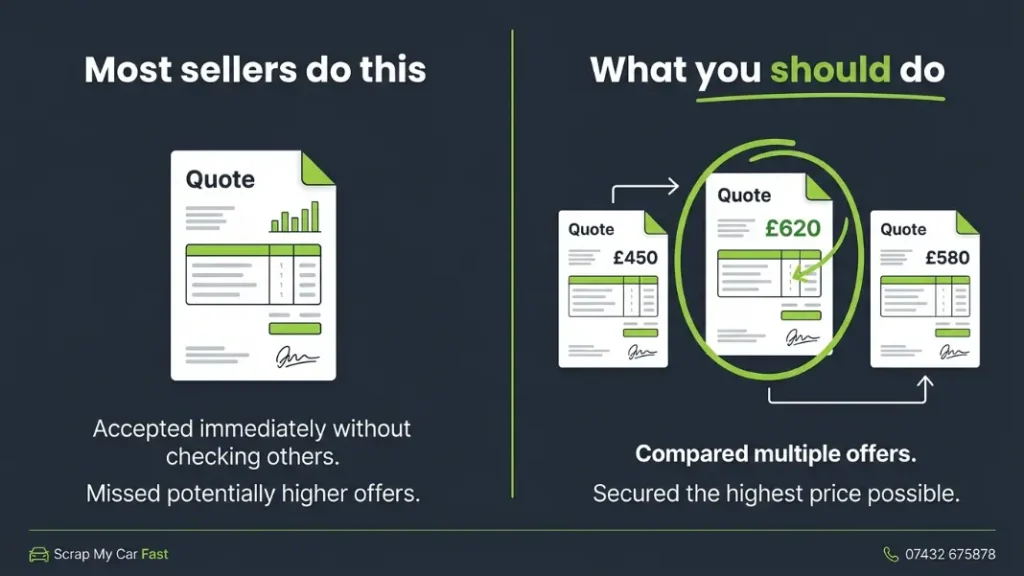
3. Get at least two or three quotes before committing
One quote gives you nothing to compare against. Two or three quotes, each free and each with no obligation, take under ten minutes and tell you a great deal about what your car is actually worth in the current market.
When comparing quotes, look past the headline number. Some buyers include free collection, same-day bank transfer, and DVLA paperwork handling as standard. Others advertise a high number, then apply a collection fee or reduce the offer when the driver arrives. The number that matters is what lands in your account after collection, not the figure on screen when you first enquire.
The difference between buyers on the same day, for the same car, can be meaningful. It is worth spending five minutes to find out rather than assuming all quotes are identical.
4. Do not strip parts from the car before collection
This is the mistake that costs sellers the most money, and it comes from logic that seems reasonable on the surface. Remove the catalytic converter and sell it separately. Take off the alloy wheels and list them privately. Pocket that money on top of the scrap value.
In practice, it usually does not work out that way.
Scrap prices are based on the vehicle’s weight. Every component you remove reduces that weight, which directly reduces your quote. A catalytic converter on a common family car weighs roughly 3 to 5kg. At £130 per tonne, removing it costs you less than a pound in scrap value. But selling that catalytic converter separately to a specialist might only fetch £30 to £50 for a standard unit, and that requires finding a buyer, arranging collection or delivery, and spending the time.
Alloy wheels follow the same logic. A set might sell privately for £80 to £120, but only if you find a buyer within a reasonable time, organise the transaction, and then put the car on steel rims or arrange the sale before collection day. The effort and the lost scrap weight often cancel out the gain entirely.
Leave the car as it is. The buyer is paying for the vehicle as it sits, and that is where the money is for most sellers.
5. Have your V5C logbook ready
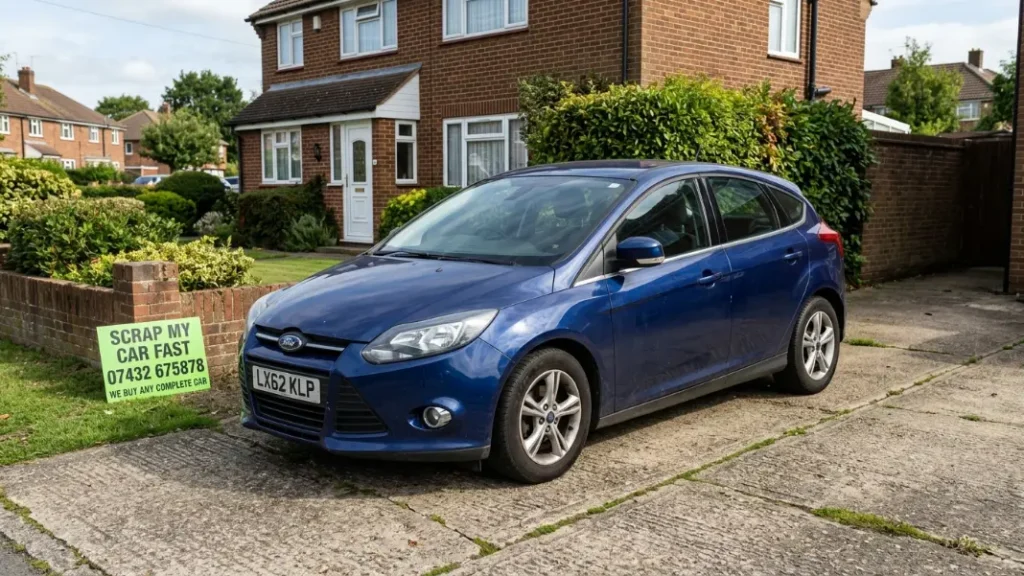
You do not always need a V5C to scrap your car. A licensed Authorised Treatment Facility can process a vehicle without one in many cases. But having the logbook ready on collection day removes one potential complication and keeps the process clean and fast.
Some buyers use a missing V5C as a reason to adjust the offer, citing extra administrative work on their side. A legitimate ATF will not make significant deductions for this, but it can slow things down. If the logbook is to hand, bring it. It confirms ownership clearly and speeds up the DVLA notification that follows.
If you have genuinely lost the V5C, our guide to scrapping a car without a logbook covers the alternative documentation you can use and how the process works without it.
6. Confirm that collection is genuinely free with no conditions
Free collection should be the standard, not a selling point. Among licensed, reputable scrap car buyers, there are no fuel surcharges, no call-out fees, no postcode premiums, and no minimum distance charges. The price agreed before collection is the price paid on the day.
Where this breaks down is with certain price comparison platforms and buyers who advertise an eye-catching headline figure, then either add a collection fee in the small print or present it verbally when the driver arrives. By that point, the car is being loaded and you are under time pressure.
Before accepting any quote, ask directly: is collection included in this price, and will this exact figure be paid with nothing deducted on collection day? Get confirmation in writing if possible. This single question filters out most of the operators who rely on arrival-day price drops.
7. Only accept payment by same-day bank transfer
Once your car has been collected, your leverage is gone. If a buyer has the vehicle and payment arrives three days later, or by cheque that takes a week to clear, you are waiting with no way to apply pressure. Legitimate scrap car buyers send payment by bank transfer the same day the car is loaded. The money typically arrives within a few hours of collection.
Cash in hand is specifically worth avoiding. Payment by cash for scrap vehicles is illegal under the Scrap Metal Dealers Act 2013. Any buyer offering cash should be taken as a clear sign they are operating outside the law, regardless of how convincing the explanation is. Beyond the legal issue, accepting cash means no traceable record of the transaction if something goes wrong later.
Same-day bank transfer is the only payment method you should accept. If a buyer cannot confirm this before collection, move on.
8. Verify the buyer holds a valid Scrap Metal Dealer licence
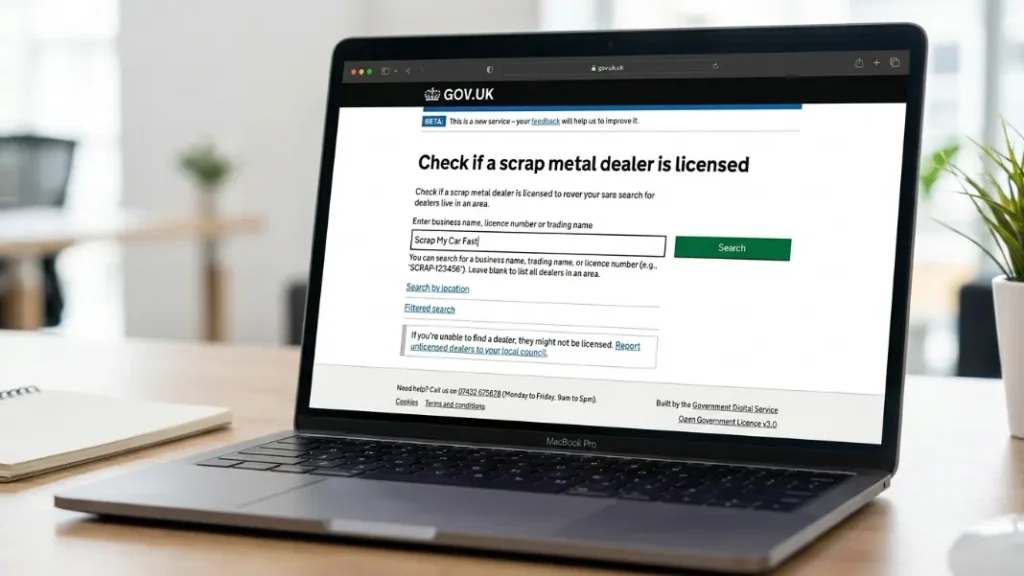
Every legitimate scrap car buyer must hold a Scrap Metal Dealer licence issued by their local authority. This is a legal requirement under the Scrap Metal Dealers Act 2013 and the licence is publicly searchable. You can verify any buyer on the GOV.UK scrap metal dealer licence check in under two minutes using the company name or address.
Licensed dealers are regulated. They cannot legally pay cash, they must verify the identity of the person handing over the vehicle, and they are accountable to their local authority for how they operate. An unlicensed operator has none of these constraints, which is why arrival-day price drops, cash payments, and missing Certificates of Destruction are almost exclusively associated with unlicensed buyers.
This check is worth doing before you enter your details anywhere. Our why customers choose us page covers what licensing requirements to look for and how to confirm a buyer is operating legally before committing.
9. If your car is 2012 or newer, mention it specifically
Newer cars often carry catalytic converters containing higher concentrations of platinum, palladium, and rhodium. The value of these metals has risen substantially over the past decade, and buyers processing larger volumes of vehicles factor this into what they offer for newer cars, particularly those from 2012 onwards.
An automated instant quote system that calculates purely on registration and kerb weight does not always capture this premium. Mentioning directly when you enquire that the car is a newer model and has its original catalytic converter in place gives the buyer the information they need to factor it in.
This also applies to vehicles with other components that carry specific value, such as low-mileage engines in good condition on certain makes, or original manufacturer alloy wheels in usable condition. Describing the car briefly rather than relying entirely on the automated system to do the work gives you the best chance of a quote that reflects the full picture.
10. Timing helps, but not as much as choosing the right buyer
Scrap steel prices tend to be softer in winter and slightly firmer in spring and early summer when construction activity increases and demand for recycled steel picks up. This is a general pattern rather than a guarantee, and global economic events can disrupt it significantly in either direction.
If you have no particular urgency and the car is not costing you money to keep, watching the rate for two to three weeks before committing is sensible. Our scrap car prices page is updated regularly so you can track how the market is moving before making a decision.
That said, the price difference between a good week and a bad week for scrap steel is typically a matter of £10 to £20 on a standard family car. The choice of buyer has a greater impact than timing. A licensed, established buyer offering a fair rate in any given week will serve you better than waiting for a peak rate and then dealing with an operator who drops the price when the driver arrives.
Get the process right first. Then consider timing.
What these tips cannot change
It is worth being direct about the limits. The core price of your scrap car is determined by its weight and the steel rate. These are objective figures. No amount of preparation, presentation, or persistence will persuade a scrap buyer to pay double the weight-based value because the car has sentimental significance, has new tyres, or has been freshly cleaned.
Mileage, colour, service history, whether the car starts or not: none of these significantly move the scrap price because none of them change what the metal is worth. Our guide to what affects scrap car value covers this in detail if you want to understand exactly which factors matter and which ones do not.
What the tips above address is the gap between what your car is theoretically worth and what you actually receive. That gap is entirely within your control.
Find out what your car is worth right now
The scrap car calculator gives you a rough figure based on your car’s weight and the current rate. When you are ready for a firm, no-obligation quote, an instant quote takes under a minute. Free collection across all ten Greater Manchester boroughs, same-day bank transfer on collection day, and all DVLA paperwork handled as standard.