
If you want to get the most from your scrap car, three things matter: how heavy your car is, whether your catalytic converter is still fitted, and keeping the car complete. Mileage, colour, cosmetic condition and whether it runs do not affect your scrap value. This guide covers every factor with real figures and five practical tips to maximise what you receive.
Why Weight Is the Most Important Factor
Scrap pricing is built on one core principle: the Authorised Treatment Facility weighs your car after removing the fluids and pays based on that weight multiplied by the current price per tonne for steel scrap. Everything else, including the catalytic converter value, is an adjustment on top of this base calculation.
This means the single biggest driver of your scrap price is how heavy your car is. A Ford Transit van weighing 2,200 kilograms will produce significantly more scrap revenue than a Toyota Aygo weighing 850 kilograms, regardless of which is in better condition or has lower mileage. The Aygo’s pristine paintwork does not change the fact that it weighs less than half the Transit.
Here are approximate kerb weights for common vehicle categories:
| Vehicle Category | Common Examples | Approx Weight (kg) | Approx Base Scrap Price* |
|---|---|---|---|
| City car | Toyota Aygo, VW Up, Smart ForTwo | 800 – 950 | £125 – £165 |
| Small hatchback | Ford Fiesta, Vauxhall Corsa, Renault Clio, VW Polo | 1,000 – 1,200 | £160 – £210 |
| Medium hatchback / saloon | VW Golf, Ford Focus, Vauxhall Astra, Peugeot 308 | 1,200 – 1,450 | £200 – £255 |
| Large saloon / estate | Ford Mondeo, VW Passat, BMW 5 Series, Mercedes E-Class | 1,500 – 1,900 | £245 – £335 |
| Compact SUV | Nissan Qashqai, Ford Kuga, Honda CR-V, Peugeot 3008 | 1,400 – 1,700 | £235 – £300 |
| Large SUV / 4×4 | Land Rover Discovery, BMW X5, Audi Q7, Volvo XC90 | 1,900 – 2,600 | £330 – £455 |
| Small van | Ford Transit Connect, VW Caddy, Peugeot Partner | 1,400 – 1,800 | £235 – £315 |
| Medium and large van | Ford Transit, Mercedes Sprinter, VW Crafter | 1,800 – 3,000 | £300 – £530 |
Add £30 to £100 for an intact catalytic converter to get the typical quotes shown on our scrap car prices page.
*Approximate base prices calculated at £175 per tonne for steel scrap, before catalytic converter value. Prices change weekly with market rates.
Scrap Metal Rates: How They Work and Why They Move
Scrap steel prices in the UK are influenced by the London Metal Exchange and by actual buying prices at UK steel mills. The rate that scrap dealers pay fluctuates week to week based on demand from steel manufacturers, energy costs at mills, and import and export dynamics.
In practical terms, the scrap price you receive for your car in spring might be £30 to £50 different from the price in autumn of the same year. This is not the scrap company being inconsistent. It reflects genuine market movement that affects every dealer in the country simultaneously.
If you want to understand current rates before requesting a quote, the Recycling Association and the British Metals Recycling Association both publish regular market commentary. The Environment Agency’s guidance for ATFs on gov.uk also explains how vehicles must be processed and what the regulatory framework looks like for the companies involved.
We collect hundreds of cars across Greater Manchester each month and update our quote engine regularly to reflect market rates. When prices drop, our quotes adjust. When prices rise, our customers benefit from stronger offers.
The Catalytic Converter: A Significant Premium on Top of Base Price
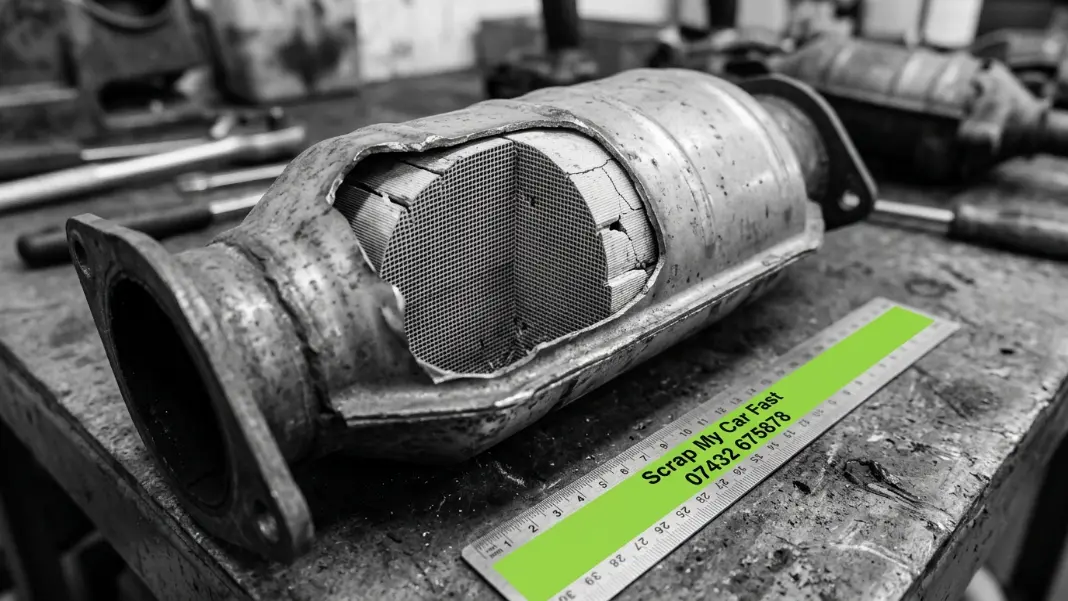
The catalytic converter sits in your exhaust system and filters harmful emissions before they leave the tailpipe. Inside it is a ceramic honeycomb coated with platinum group metals: platinum, palladium and rhodium. These metals are expensive and are recovered during ATF processing.
The value of a catalytic converter varies significantly by make and model:
- High-value cats: Honda Jazz (pre-2020), Honda CR-V (pre-2019), Toyota Prius, Toyota Auris, BMW 3 Series petrol, Mercedes C-Class petrol. These models have cats with higher platinum and palladium content. Their cats can add £30 to £150 or more to a scrap quote depending on current PGM prices.
- Mid-range cats: Most mainstream petrol hatchbacks from Ford, Vauxhall, Volkswagen, Renault and Peugeot. Adds £30 to £60 to the base quote.
- Lower-value cats: Older diesel models from the 1990s and early 2000s. Diesel catalysts from this era contain less palladium than petrol cats and were simpler in design. They add less to the overall quote.
- Modern diesel particulate filters: Newer diesel vehicles with both a diesel oxidation catalyst and a diesel particulate filter (DPF) have more complex exhaust systems but the DPF itself does not contain PGMs in the same way. The platinum content is present but lower per unit than equivalent petrol cats.
What this means in practice: if your catalytic converter has been stolen, your scrap quote will be lower than if the cat were intact. Always mention a missing cat when you request a quote so the price reflects the vehicle’s actual state from the start.
How Make and Model Affect Scrap Value
Beyond the catalytic converter, the make and model of your car influences scrap value in a few ways that are worth understanding.
Aluminium-Heavy Vehicles
Aluminium is worth significantly more per tonne than steel scrap. Vehicles that use extensive aluminium in their body structure or engine blocks fetch a better return at the scrap yard because the aluminium is separated and sold at a higher price. Jaguar, Land Rover and several premium German brands have used aluminium-intensive construction for their body-in-white structures. When these vehicles are processed, the aluminium content improves the overall return for the ATF and can support a better quote for you.
Hybrid Vehicle Battery Packs
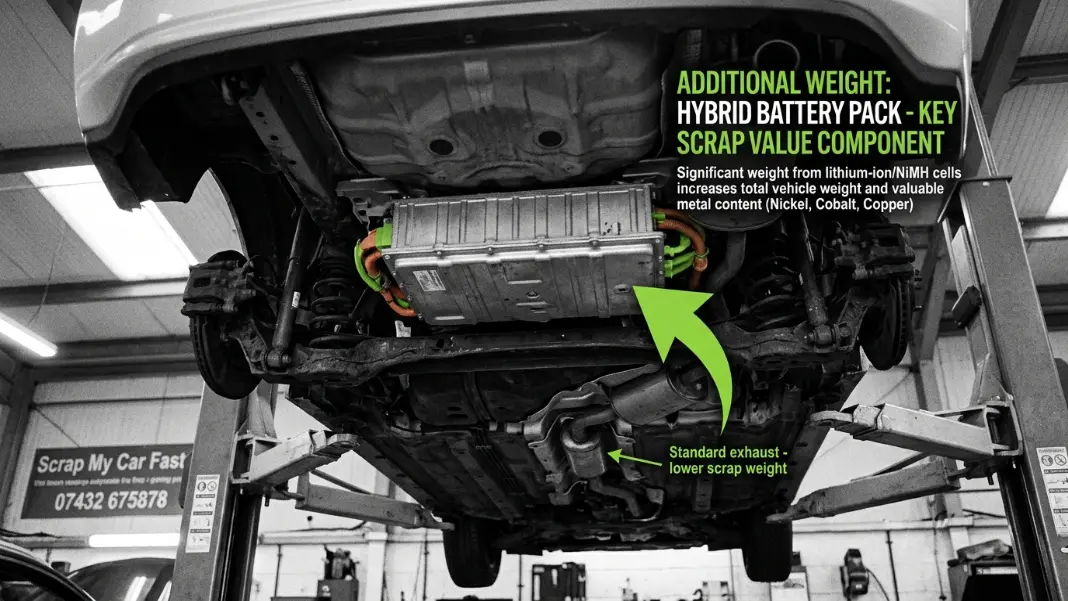
Hybrid vehicles contain a large battery pack, typically nickel-metal hydride or lithium-ion, in addition to a conventional engine. These battery packs add weight and have material recovery value beyond standard steel scrap. In our experience, hybrid vehicles often fetch slightly more than their non-hybrid equivalents at scrap because of the additional recoverable material from the battery system.
Parts Demand for Specific Models
Most scrap values are set by weight and metal content, not by the used parts market. However, some ATFs have working relationships with parts recyclers who buy end-of-life vehicles for disassembly before full processing. In those cases, popular models with strong aftermarket parts demand, such as Golf, Focus or BMW 3 Series, may be worth slightly more than their straight metal value. This is not something that dramatically changes most quotes, but it is a factor at some facilities.
Does Condition Actually Matter for Scrap?
This is one of the biggest misconceptions about scrapping a car. People expect their vehicle’s condition to affect its scrap value the way it would in a private sale. It largely does not.
For scrap purposes, here is what condition does and does not affect:
- Scratches, dents, rust and cosmetic damage: Essentially zero effect on scrap value. The car is processed for its metal content, not its appearance.
- Insurance write-off status: A Cat N, Cat S or even Cat B write-off is scrapped at the same weight-based rate as an undamaged car. The write-off categorisation relates to the car’s economic viability as a repaired vehicle, not its metal content.
- Running vs non-running: A non-runner is worth the same as a running car of the same weight. The only practical difference is the collection method: a non-runner typically needs a flatbed rather than a drive-on collection.
- Completeness: This is what does matter. A car with a missing catalytic converter, stripped interior, removed wheels or absent engine weighs less and therefore is worth less. Completeness is the condition factor that genuinely affects scrap value.
Does Mileage Affect Scrap Value?
No. A 200,000-mile Ford Mondeo and a 20,000-mile Ford Mondeo of the same model year and specification are worth exactly the same as scrap. Mileage affects a car’s value on the used market because it indicates wear and remaining life. Scrap buyers care only about the metal they can recover from the vehicle, and metal does not wear out with mileage.
Petrol, Diesel, Hybrid and Electric: How Drivetrain Affects Value
Petrol
Standard petrol cars are processed efficiently and their catalytic converters tend to have higher PGM content than comparable diesel cats. For the same vehicle weight, a petrol version often earns slightly more than its diesel equivalent because of the higher-value cat.
Diesel
Diesel engines are generally heavier than their petrol equivalents, which increases the base weight and therefore the base scrap value. However, earlier diesel catalytic converters have lower PGM content, so the two factors partially offset each other depending on the specific vehicle and the current platinum-group metal prices.
Hybrid
Hybrid vehicles tend to be heavier due to the battery pack, which increases base scrap value. The battery also has additional recovery value. In our experience collecting across Greater Manchester, hybrids often achieve slightly stronger prices than their non-hybrid equivalents when the overall vehicle weight and battery value are considered together.
Electric
Electric vehicles present a more complex picture. They do not have catalytic converters, so there is no PGM premium. The battery pack is a large, heavy component with significant material value, primarily lithium, nickel and manganese, but the processing of EV batteries at scale is still developing across the UK.
Some ATFs apply a handling cost for EV batteries rather than a premium, because the specialist depollution and processing of large lithium packs requires additional equipment and process steps. This is changing as infrastructure matures and more EV batteries reach end-of-life, but it means current EV scrap prices may be lower than the vehicle’s weight alone would suggest. If you have an electric vehicle to scrap, call us directly to discuss current pricing before requesting an online quote.
Does Location Affect Scrap Prices?
Location can affect scrap prices in two ways. First, collection distance: some dealers charge for collection beyond a certain radius, which effectively reduces your net payout. We do not charge for collection anywhere in Greater Manchester. The price you receive is not affected by whether you are in Manchester city centre or in Wigan, Bolton, Leigh or Rochdale.
Second, regional scrap metal demand: steel mills and processing facilities are not evenly distributed across the UK. Areas with strong industrial demand locally, such as the Northwest and Yorkshire, tend to have more competitive pricing from local ATFs because transport costs to the mill are lower. Manchester benefits from its proximity to steel processing infrastructure in the region.
Does Time of Year Affect Scrap Prices?
There is a mild seasonal pattern in scrap metal prices, though it is not dramatic enough to plan your timing around. Steel production tends to be stronger in spring and early summer as construction activity picks up. August can see softer scrap prices as some mills undertake scheduled maintenance. The difference between the best and worst month in a typical year is rarely more than £20 to £40 on a family hatchback.
If your car needs to go, do not hold onto it for months waiting for the perfect scrap price. The depreciation in having an unwanted car sitting on your drive, the insurance cost if you maintain cover, and the SORN administration if you declare it off-road will typically outweigh any seasonal price advantage.
What You Can Do to Maximise Your Scrap Price
Given the factors above, here is what you can actually do to get the most from your scrap car:
- Keep the catalytic converter in place. Do not remove it or allow it to be stolen without telling us about it when you book. A complete car earns more than one with the cat missing, and removing your own cat is rarely worthwhile when compared to what it adds to the total quote. A working catalytic converter adds £30 to £150 to your scrap quote depending on the vehicle. A Honda Jazz, Toyota Prius or Honda CR-V cat is at the top of that range. Removing it yourself rarely makes financial sense, as selling it separately rarely pays more than it adds to your whole-car quote.
- Keep all four wheels on the car. A full set of wheels adds weight and makes collection more straightforward. Removing wheels before collection typically reduces rather than improves your payout. Four wheels on a typical family hatchback contribute roughly 80 to 120 kg. At current steel rates that is £14 to £21 in base scrap value alone, before any alloy premium. Removing them costs you more than you gain from selling them separately unless you have desirable alloys in excellent condition.
- Do not strip the interior. Seats, door cards and dashboard components add to the vehicle’s weight and therefore its scrap value. Removing them is counterproductive if your goal is to maximise the scrap price. The full interior of a medium hatchback adds 80 to 150 kg to the vehicle’s kerb weight. Stripping it reduces your scrap price by £14 to £26 at current rates and leaves you with components that are difficult to sell individually.
- Be accurate in your description when requesting a quote. An accurate description produces a quote that holds on collection day. An overestimated description leads to a price reduction when the driver arrives and finds the car is not as described. Accuracy protects you from disappointment at collection.
- Check current prices before you book. If you have flexibility on timing and know that metal prices are currently moving upward, waiting a week or two before requesting a quote can sometimes produce a better number. This is marginal, but it is real.
Common Misconceptions About Scrap Value
A few things that do not affect scrap value the way people often expect:
- A newer car is worth more as scrap. Not necessarily. A new small car weighs less than an old large car. Scrap value follows weight and metal content, not year of manufacture. A 2005 Land Rover Discovery may scrap for more than a 2020 Toyota Aygo.
- A rare or classic car is worth more as scrap. Rarity has no scrap value at all. If you have a rare classic or collectable vehicle, explore restoration or parts sale before scrapping it. The collector market will almost always offer more than the metal value.
- Cleaning the car before scrapping increases the price. There is no need to clean it. The ATF will drain all fluids regardless of the car’s state. Presentation has no effect on metal content.
- A written-off car is worth significantly less as scrap. An insurance write-off categorisation does not reduce scrap value. The write-off relates to the car’s viability as a repaired vehicle. Its metal content is identical whether or not it has been written off.
Frequently Asked Questions
What is the most important factor in determining scrap car value?
Vehicle weight is the single most important factor. Scrap cars are priced per tonne for their steel and other metal content. A heavier car produces more recoverable metal and therefore earns a higher price. The catalytic converter is the main secondary factor, adding a premium based on its platinum group metal content.
Does it matter if my car is running or not for scrap value?
For scrap value, no. A non-runner is scrapped at the same weight-based rate as a running car. The practical difference is in the collection method: a non-runner may require a flatbed truck rather than a drive-on collection. Let us know the car’s condition when you book so we can arrange the right vehicle.
Why does my scrap car quote change from one week to the next?
Scrap metal prices move with the market. Steel scrap rates at UK processing plants are updated regularly, sometimes weekly. The price change reflects genuine market movement, not inconsistency from the scrap company. Commodity prices affecting scrap steel are publicly tracked by the London Metal Exchange and industry bodies.
Does a missing catalytic converter reduce my scrap price?
Yes. The catalytic converter contains platinum group metals that are recovered during processing. If your cat is missing, the overall recoverable metal value of your car is lower. Always mention a missing cat when requesting a quote so the price is accurate from the start and there are no adjustments on collection day.
Is an electric car worth more or less as scrap than a petrol car?
Electric vehicles do not have catalytic converters, so there is no PGM premium. The battery adds weight and material recovery potential, but EV battery processing infrastructure is still developing in the UK. Contact us directly if you have an EV to scrap so we can give you an accurate current price based on today’s market conditions.
Does removing parts from my car before scrapping increase my payout?
Almost always no. Removing parts reduces the vehicle’s weight, which reduces the base scrap price. The parts you remove are worth less sold separately in most cases than they add to the complete vehicle quote. The one exception is if you have rare or high-demand parts on a desirable vehicle, in which case a specialist parts trader rather than a scrap dealer may be worth exploring.